Ultra-High Resolution Data Collection
Ultra High Resolution Data Collection Strategy
- Care should be taken not to damage the detector plate with severely overloaded reflections: the large diameter beam stop should be used to prevent this!!!
- Ultra-high resolution reflections are normally weak and therefore long exposure times are required. As a result the low resolution reflections are lost due to overloaded pixels.
- An ultra-high resolution experiment usually requires the collection of at least two data sets: first, a long exposure, high-resolution set (since radiation damage affects the highest resolution reflections first) and then a short exposure low-resolution set to complete the overloaded reflections from the first data set. The data sets should have at least 1/2 Angstrom overlap to allow them to be scaled together.
- To optimize spot separation, the detector should be positioned so that the limit of diffraction from the crystal is just within the plate. Sometimes the crystal may diffract beyond the limits of the experimental setup.
- It is very important that the detector is not positioned so close to the sample, in an effort to obtain the highest resolution, that the reflections are not adequately resolved. A separation of at least 10 pixels is typically required.
- A collection strategy should be generated using the strategy option of mosflm. Strategy can determine both the starting angle and and rotation range for a complete data set.
- Also, the testgen option in
mosflm should be used to check the number of overlapped reflections, which may be a problem at shorter wavelengths. If overlaps are a problem one may use a smaller rotation range. NB: you need a good estimate of the crystal mosaicity for reliable results from testgen.
An ultrahigh-resolution experiment usually requires long exposure times, resulting in significant losses in the strong low-resolution shells due to overloaded pixels.
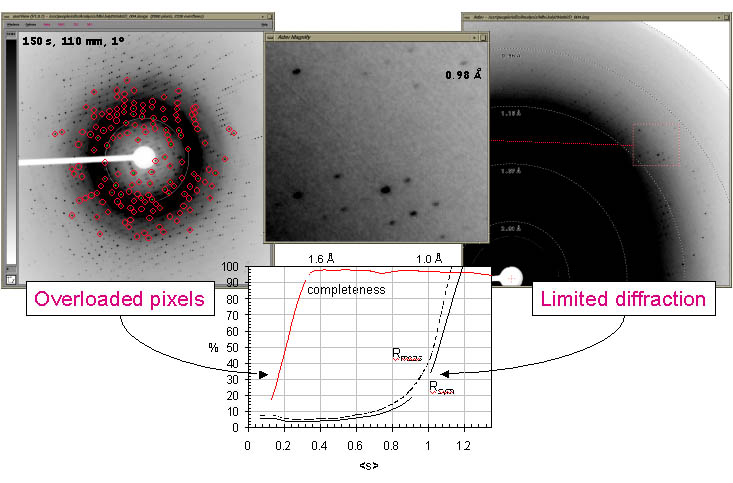
A second low-resolution data set is required to fill in the missing low-resolution data.
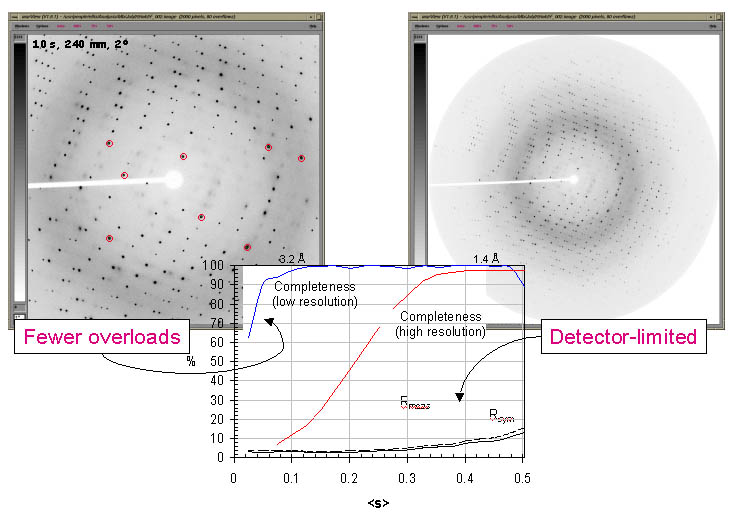
The low-resolution data sets are collected with the detector further from the sample and the exposure time greatly reduced. For the purposes of scaling the data sets together, the maximum resolution should be chosen to give a substantial overlap with the high-resolution set (i.e. ~0.5 A).
|
