Cryogenic Shipping Dewar
Testing and Shipping
Introduction
Safety and Precautions
Obtain a Dry-Shipping
Dewar
Find the "Empty Weight" of the Dewar
Properly Charge the Dewar
Inspect for Catastrophic Vacuum Failure
Measure Liquid Nitrogen Loss Levels
Find the "Charged Weight" of the Dewar
Shipping Dewars to SSRL
To avoid sample loss during shipping to SSRL, it is
important to check that your dry-shipping dewars are functioning
properly before use. We strongly recommend testing that the dewar can
maintain cryogenic temperatures for the duration of transit time.
Shipping dewars to SSRL often requires 2 to 3 days of transit
time. Occasionally problems with the shipping company can result in
shipments that take more than a week.
The following directions will describe 1) how to obtain
a dry-shipping dewar compatible with the SAM system, 2) how to test your
dry-shipping dewars for performance, and 3) how to ship samples to SSRL for
remote access data collection. Always plan ahead to allow adequate time
to implement the procedures described in this section before samples need to be
shipped to SSRL.
Dewar performance ultimately depends on how long
samples can be stored in the dewar at cryogenic temperatures. Sample storage time will be
degraded by either an excessive liquid nitrogen evaporation rate or a
reduced holding capacity for liquid nitrogen. The liquid nitrogen
evaporation rate is influenced by the integrity of the insulating
vacuum in the dewar. In general, performance degradation can be attributed to either 1)
catastrophic or gradual vacuum loss or 2) accumulation of moisture in the
liquid nitrogen absorbent material or 3) damage and loss of portions of the
absorbent material.
We recommend that you check the performance of your
dry-shipping dewars at least every 6 months and ideally before each use.
Use
this
worksheet to assist you with dewar testing. Please note that this
worksheet is NOT a substitute for reading the directions; it is merely a
device that may be useful in testing the performance of your dewar.
-
Handle the dewar with care. A strong impact to the
outside of the dewar or the neck can cause vacuum failure.
-
Important:
Read the
safety notes before working with liquid nitrogen and make sure you
are familiar with the liquid nitrogen safety procedures at your
institution.
-
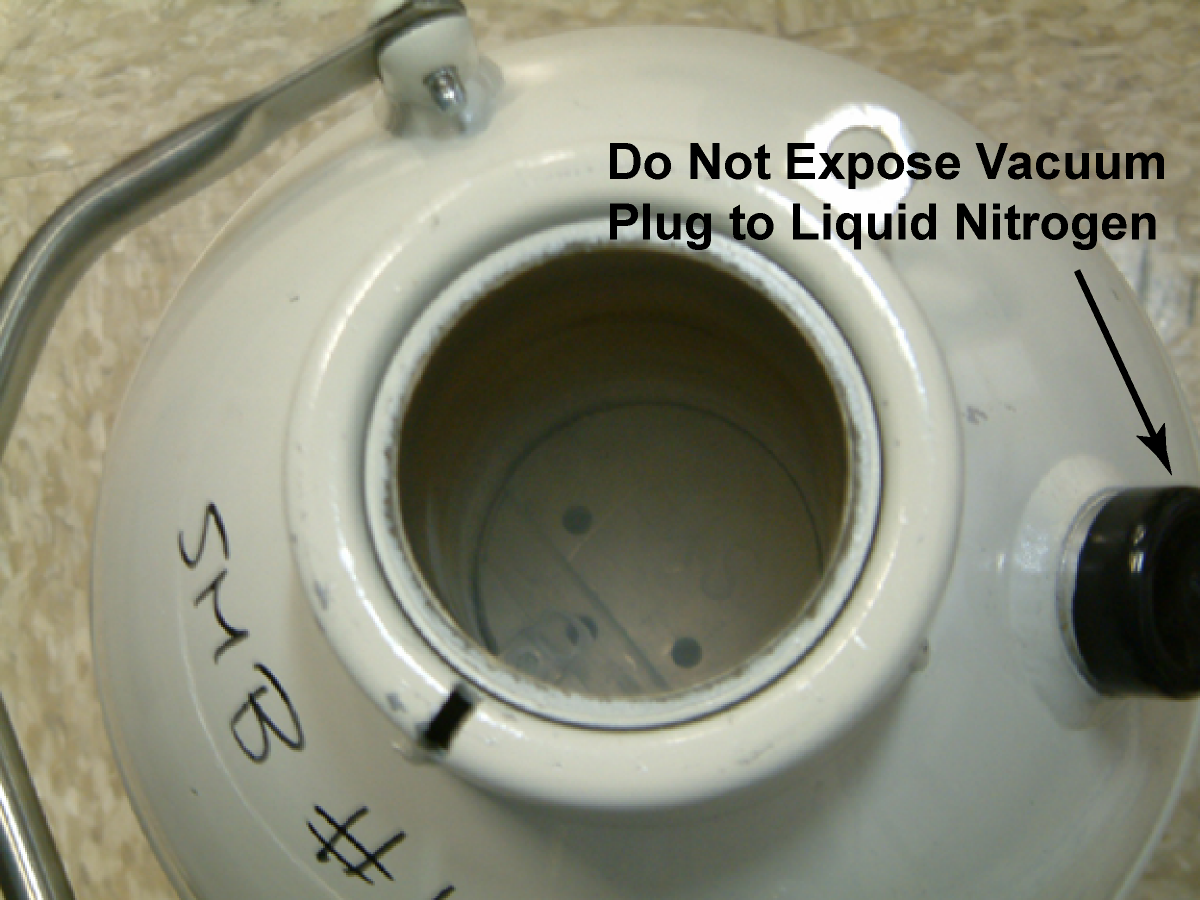
Avoid spilling liquid nitrogen over the vacuum plug
near the top of the neck. Exposure of the vacuum plug to liquid nitrogen
can shrink the seal causing air to leak into the insulating vacuum space
reducing the performance of the dry-shipping dewar. A protective cover
for the vacuum plug can be made from Styrofoam.
A dry-shipping dewar is used to ship
samples at cryogenic temperatures in a safe manner without the
possibility of spilling liquid nitrogen out of the shipping container
during transport. The shipping dewar contains a liquid nitrogen
absorbent material that must be properly charged with liquid nitrogen
before use. A properly charged and well functioning dry-shipping dewar will keep crystals at temperatures below 90 K for at least a
week.
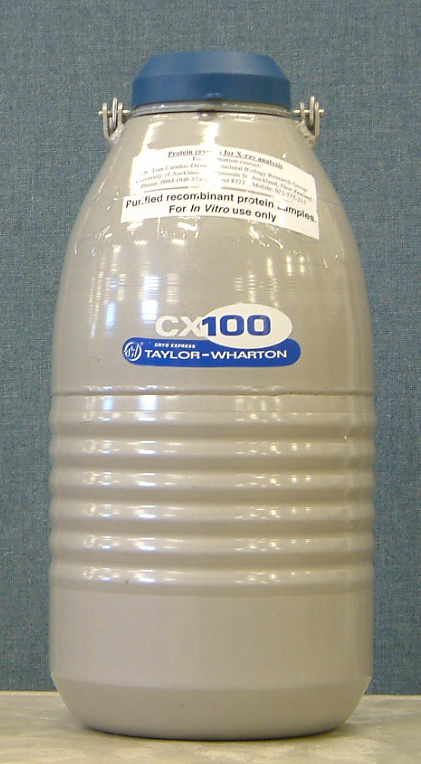
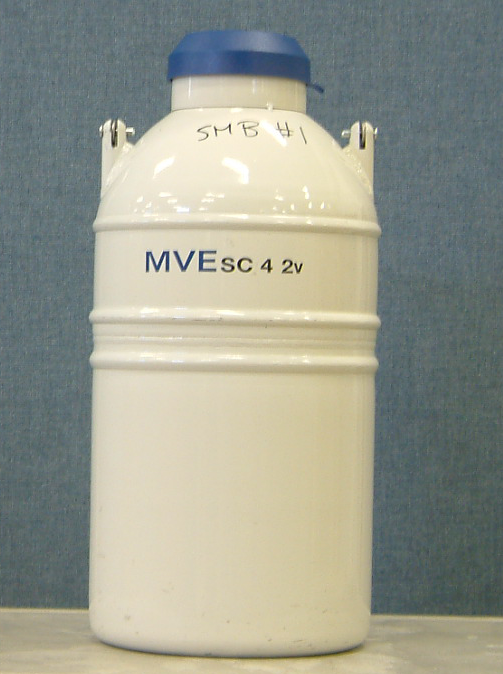
Two types of dry-shipping dewars are
approved for shipping the SSRL crystal storage cassettes and uni-pucks which
are used by the
Stanford Automated Mounter (SAM) for remote access data collection.
These are the Taylor Wharton CX100 and CXR100R and the MVE SC4/2V dewars:
Taylor-Wharton Cryogenics
4075 Hamilton Boulevard
Theodore AL 36582
Tel: 1-251-443-8680
Customer Service: 1-800-898-2657
Web: http://www.taylorwharton.com/
Email: twsales@taylorwharton.com
Taylor Wharton CX100 Shipping Dewar
MVE Biological Systems Applied Technologies
Division,
Chart Industries Inc.
3505 County Road 42
West Burnsville, MN 55306-3803
Phone 1-952-882-5000 1-888682-2796
Web: http://www.chart-ind.com/
MVE SC 4 2V Shipping Dewar
How to Test Your Dry-Shipping Dewars for Performance
There are 5 steps required to complete the testing process: 1) find the
empty weight of the dewar, 2) properly charge the dewar, 3) inspect for
catastrophic vacuum failure, 4) measure the liquid nitrogen loss level and
5) determine the charged weight of the dewar.
1)
Remove the dewar from the shipping container and measure the empty
weight of the dewar without the lid (remove any cassettes, canisters, Teflon
rings, etc.). Make sure the dewar is at room temperature.
2)
Use a balance similar to an
Adam Equipment CPWplus 35P to determine the empty weight of the dewar.
If the dewar is new, mark the weight on the side of the dewar with permanent
marker. This weight will be considered the “as new” weight. The dewar is
considered acceptably dry if it weighs within 1 lb of the ‘as new’ weight.
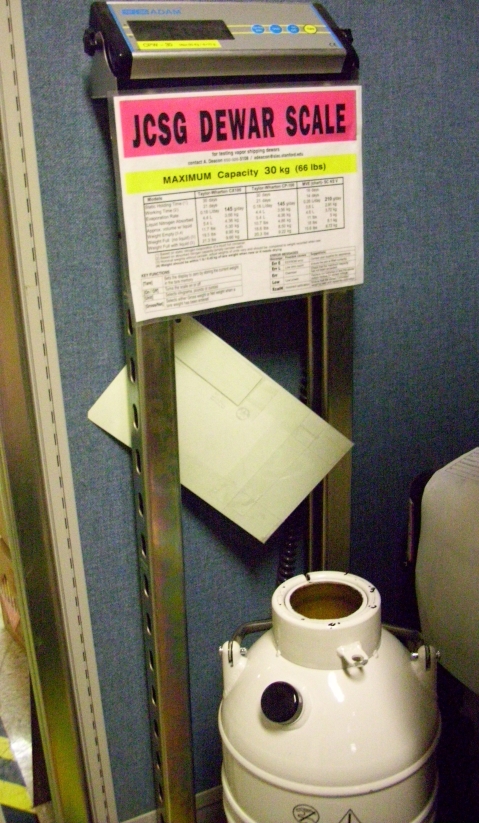
Using a scale similar to an Adam Equipment CPWplus 35p, find the weight
of the shipping with no lid or accessories.
3)
If the “as new” weight is known and the dewar weighs 1 lb more than
the ‘as new’ weight, make sure that the dewar is acceptably dry before
proceeding. Drying can be accelerated by application of a dry nitrogen or
air purge. It may take several days to properly dry the shipping dewar.
4)
If you do not know the ‘as new’ weight, the shipping dewar should be
thoroughly dried and the weight recorded. It may take several days to
properly dry the shipping dewar. To verify the dewar is dry, the weight of
the dewar may be monitored until it no longer decreases during drying. The
dry weight should be recorded on the dewar with a permanent marker.
1)
Take the cap off the dewar and pour liquid nitrogen into the dewar until it is full. Avoid spilling on the vacuum plug.
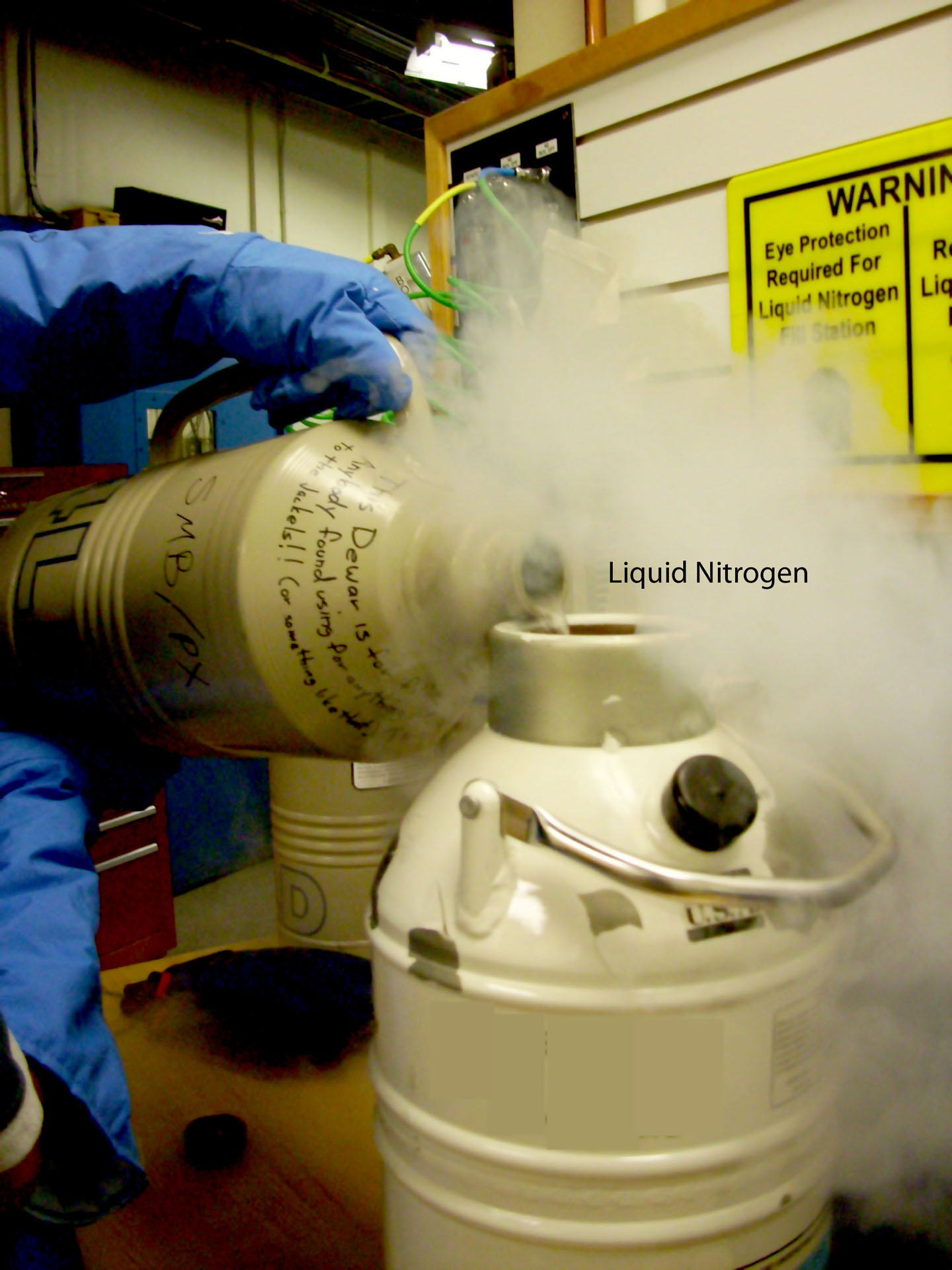
Using a transfer dewar, pour liquid nitrogen into the shipping dewar.
This process may need to be completed 4-5 times to properly charge the
dewar.
2)
Put the cap on the dewar to prevent moisture condensation inside.
3)
Wait 20 minutes.
4)
Repeat steps 1-3 until liquid nitrogen remains at the
top edge of the dewar. This ensures that the absorbent material is
saturated with liquid nitrogen.
5)
Pour out all excess liquid nitrogen. This leaves the absorbent
material fully charged, a requirement for successful dry shipping.
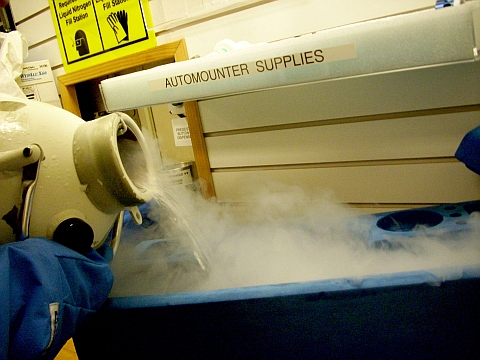
Pour out all excess liquid nitrogen such that only the absorbent material
contains nitrogen.
1)
Wipe the outside of the dewar dry with a cloth.
2)
Wait 2-3 hours.
3)
If excessive condensation has formed on the outside of the dewar (see
pictures below) the vacuum has failed. Do not use this dewar (and contact your manufacturer to have the
dewar repaired).
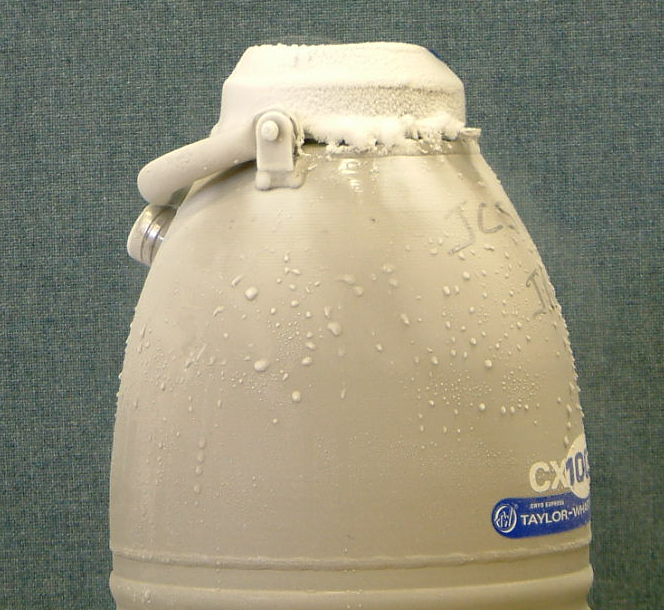
Excessive condensation (left photo) or frost (right photo) on the outside of
the dewar indicates the dewars insulating vacuum has failed.
This test is designed to measure the vacuum quality of your dewar. A dewar with a good vacuum will retain liquid nitrogen longer than a dewar
with a poor or compromised vacuum.
1)
Properly charge the dewar with liquid nitrogen following the
instructions above (the excess liquid nitrogen does not need to be poured
out of the dewar for this procedure).
2)
Fill the dewar with liquid nitrogen until liquid nitrogen is at the
top edge of the dewar.
3)
Place a meter stick into the dewar to measure the level of liquid
nitrogen in mm. Record the value on the meter stick. Remember to
put the cap back on the dewar to prevent moisture condensation inside the
dewar.
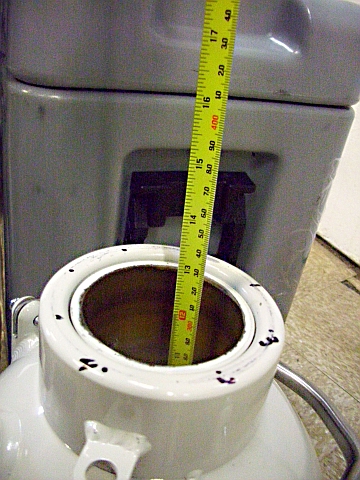
Firs
Tip: Use a wooden measuring stick to measure the level, then take it out of the dewar and shake it
around. You will notice frost or condensation on the places where the measuring
stick had contact with liquid nitrogen. Look for the highest point of
condensation
and record this value as the height of liquid nitrogen in the dewar.
4)
Wait 24 hours
5)
Remove cap from dewar and repeat steps 3.
6)
If the level of liquid nitrogen decreases by 150 mm in 24 hours (or
if it loses more than 100 mm in 16 hours) the dewar vacuum may be
insufficient or dewar enclosure may be damaged (for example the connection
between the dewar neck and body may be ruptured) Inspect the
dewar for damage. This dewar should not be used for dry-shipping.
This test is designed to measure the quality of your dewar's absorbent
material. A dewar that performs well in this test will be dry and thus have the
capacity absorb a proper amount of liquid nitrogen into the absorbent material.
1)
Find the empty weight of the dewar following the instructions above.
2)
Fully charge the dewar following the instructions above. Pour out any excess liquid nitrogen.
3)
Measure the weight of the dewar without the lid (and remove any cassettes, canisters, Teflon rings, etc.).
a.
Subtract the weight of the charged dewar with the weight of the dewar
when it is empty and dry. This weight represents the amount of liquid
nitrogen retained by the absorbent material.
i.
For Taylor Wharton CX-100, the absorbent material should hold 4.4
L of liquid nitrogen corresponding to a weight increase of 3.6 kg over the dry
weight. According the manufacturer, this is equivalent to a working time
of 21 days (if the vacuum has not been compromised).
ii.
For the MVE SC4/2, the absorbent material should hold about 3.8 L
of liquid nitrogen or the weight should increase by 3.1 kg over the dry
weight. According the manufacturer, this is equivalent to a working time
of 14 days (if the vacuum has not been compromised).
b.
If the weight of the liquid nitrogen retained is less than the amount
specified above, the holding time of the dewar is reduced. This can happen
if absorbent material contains a lot of moisture or if the absorbent
material has been damaged and a portion lost. If the amount of
liquid nitrogen retained by the dewar is low, the dewar should be
dried and the above measurements repeated.
c. For dewars with good vacuum
quality, the working time
for the dewar may be calculated by multiplying the ideal working time (21
days for the CX100 and 14 days for the SC4/2) by the ratio of the measured
mass of the liquid nitrogen retained by the shipping dewar divided by the
ideal mass of liquid nitrogen that should be retained (3.6 kg for a CX100 or
3.1 kg for a MVC SC4/2). Note: The holding time
may be further reduced if the vacuum inside the dewar is of insufficient
quality as determined by "the liquid nitrogen loss level test" described in
the previous section.
(your dewar working time in days) = (manufacturer
specified working time in days) x (the amount of liquid nitrogen
retained by your dewar in kg) / (the ideal amount of retained liquid
nitrogen in kg)
If your dewar does not have 10 days of
sufficient working time and good vacuum quality, do not use it to ship samples to SSRL.
| 